
Construction
4 minute read
"To reduce our climate impact and meet increasing customer requirements, we use renewable fuels"
Highlights
Strukton Rail is a private railway contractor that designs, builds, and maintains tracks and railway systems. Strukton is part of the Dutch Strukton Groep. To learn more about their Swedish operations, we met with Sustainability Manager Carolina Österberg.
Carolina, what are your targets regarding your vehicle fleet?
Carolina explains: "Our primary vehicle target is to transition to a renewable and electrified vehicle fleet by 2030. We have had this goal since joining Fossil Free Sweden in 2019, and it aligns well with our customers' requirements. Because our largest climate impact comes from our vehicles, that is where we can make the biggest difference. Our fleet consists of passenger cars, light and heavy trucks, construction machinery, and large heavy rail vehicles. We are on schedule replacing passenger cars and light trucks with electric vehicles. Construction machinery and rail vehicles are currently harder to electrify due to high costs and technical limitations in power output and capacity. Therefore, the goal is that vehicles that cannot be powered by electricity by 2030 will be fueled exclusively with renewable fuels, with HVO100 serving as the primary solution."
Tell us how your customers have driven your own transition?
Carolina elaborates: "Our largest customer, Trafikverket (the Swedish Transport Administration), has set clear requirements for renewable fuels in its procurements. In recent tenders, 40–50% of all fuel used in projects must consist of renewable fuels up to 2025. After that, requirements increase annually, reaching 100% renewable fuel requirements by 2030. In addition, there are requirements for an increasing proportion of electric vehicles per contract year."
Where do you stand in Sweden compared to your international parent and sister companies?
Carolina: "We are at the forefront within the group, largely because our Swedish customers set high and clear requirements in their procurement processes."
You have nearly a thousand employees in Sweden. How do they view your focus on renewable fuels? Carolina: "The transition from fossil diesel to HVO100 has gone very smoothly. It has mainly been about adapting routines. The questions that have arisen have rather concerned electric vehicles, primarily around range, charging infrastructure, and load capacity."
And how do you handle refueling?
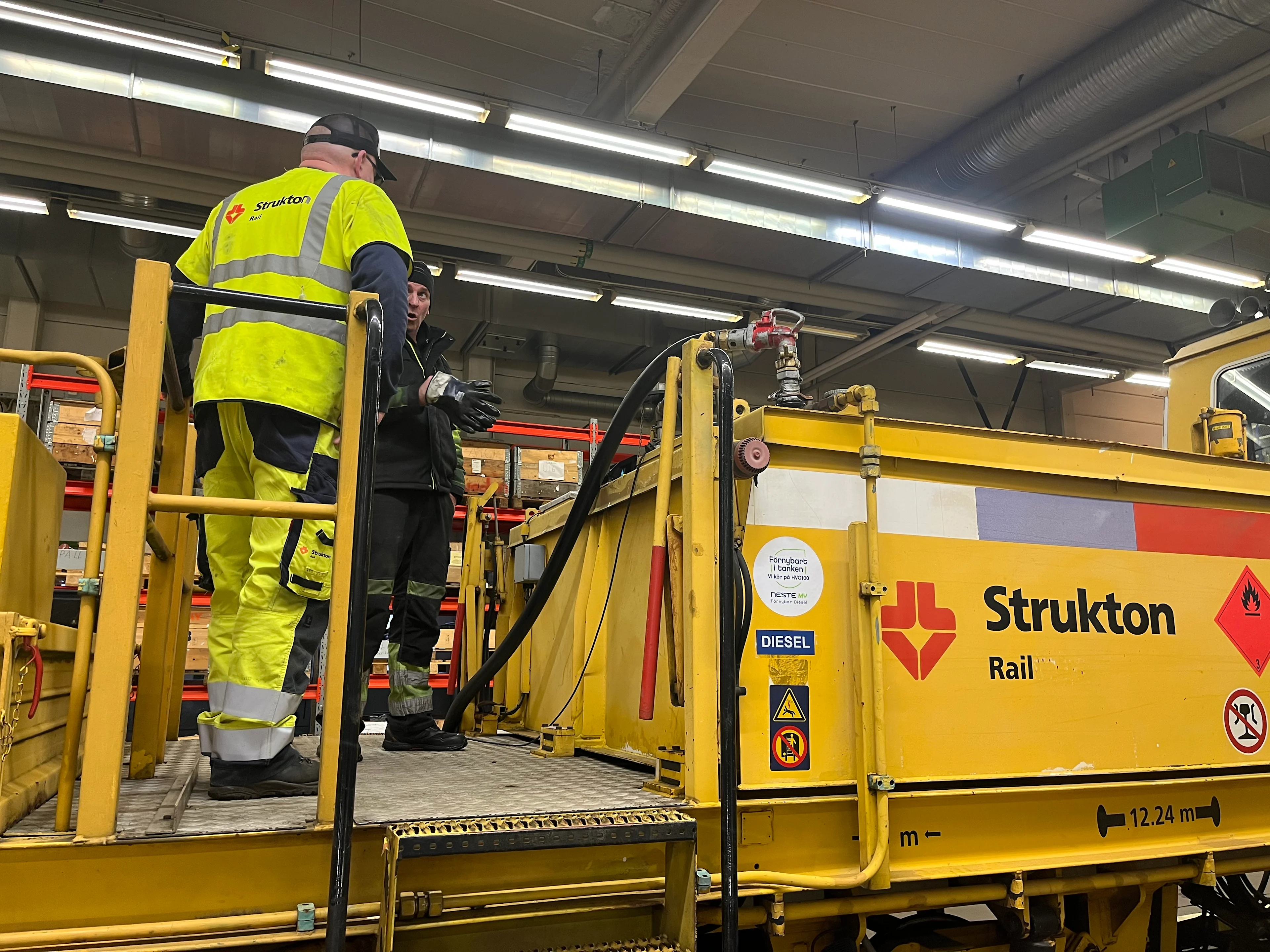
You operate across the entire country. Carolina: "For standard vehicles, refueling at stations where HVO100 is available is straightforward. In northern Sweden, where we hold maintenance contracts, we installed three of our own fuel tanks to secure supply. The biggest challenge involves rail machinery, which must be refueled directly in track environments via tank trucks or localized storage tanks. In 2022, we established a depot in Linköping where, in collaboration with Energifabriken, we plan to install our own storage tank to facilitate refueling during service and passing transport."
What challenges did you face when choosing to switch to Neste MY Renewable Diesel™?
Carolina reflects: "All our diesel-powered cars and machinery are approved for HVO100, which was the first thing we verified. Strukton has also updated its rail machinery with new engines to meet current emission standards. Logistics in track environments and the price difference compared to subsidized fossil rail diesel have been challenges, as well as political unpredictability making long-term investments more difficult. When hiring construction machinery through subcontractors, we clarify in project agreements that they must be fueled with renewable fuel."
Why did you choose Neste MY Renewable Diesel™ when you made the switch?
Carolina: "We were contacted by Energifabriken, which distributes Neste MY Renewable Diesel™, at a time when we were seeking renewable fuel solutions. It was crucial for us to confirm that the fuel complies with strict sustainability criteria and that traceability and security of supply could be guaranteed via dedicated storage tanks."
What advice would you give to a company about to begin its transition?
Carolina is clear: "Switching to HVO100 is a very straightforward first step if you operate diesel vehicles. It requires no engine modifications and can deliver an immediate reduction in greenhouse gas emissions compared to fossil diesel."*
*) Neste MY Renewable Diesel™ sold in the EU is an HVO fuel complying with the sustainability criteria set out in the EU Renewable Energy Directive (EU RED III), including the requirement to provide at least a 50% reduction in greenhouse gas emissions over its life cycle compared to fossil diesel.
Strukton Rail AB is part of the Dutch Strukton Group, which has approximately 6,500 employees and operations in five European countries, as well as in the US and Australia. The company designs, builds, and maintains tracks and railway systems. Approximately 1,000 people work at Strukton in Sweden, with net sales of over SEK 2.6 billion. Strukton Rail purchases Neste MY Renewable Diesel™ via Neste's distributor, Energifabriken.