Renewable solutions
5 minute read
The power of partnership: renewable solutions in heavy-duty operations
Addressing the climate impact of heavy-duty logistics and material handling operations requires more than a one-size-fits-all approach. Discover how cross-industry collaboration is proving that renewable fuels are readily available and operationally viable today for existing machinery and infrastructure.
In heavy-duty material handling, operational continuity is non-negotiable. Machines lift, move, and transport immense loads around the clock. Here, addressing GHG emissions cannot come at the expense of uptime or performance.
By looking at ongoing collaboration between Neste, engine manufacturer Volvo Penta, and equipment provider Kalmar, a clear blueprint emerges: fuel, engine, and machinery must work in harmony to deliver practical, scalable climate action today.
Balancing operational continuity with reduced carbon footprint
Heavy logistics and material handling operations face unique hurdles related to GHG emissions reduction. While passenger transport leans heavily toward electrification, the heavy-duty sector requires multiple solutions, because the electric grid is not always accessible or powered by renewable energy.
For massive industrial equipment, battery power comes with distinct physical and logistical limitations. Anders Wernersson, Product Manager Offroad at Volvo Penta, notes that replacing, for example, a large 400-to-500-kilowatt engine with batteries requires an immense battery capacity, resulting in long charging times and the need for heavy-duty grid connections.
This is where a drop-in fuel solution like Neste MY Renewable Diesel™ (HVO100) becomes an operational necessity. As Mats Hultman, Head of OEM Partnerships at Neste, explains, operators can transition to HVO100 effortlessly because it utilizes existing infrastructure.
When dealing with heavy-duty demands, the energy density of HVO is simply hard to compete with.
"Switching to a drop-in fuel is a solution that doesn’t require any new capital investments from operators. They don't need to purchase new machinery or overhaul their infrastructure. When dealing with heavy-duty demands, the energy density of HVO is simply hard to compete with," Hultman says.
Life cycle GHG emissions as the true measure of impact
To genuinely lower the climate impact of heavy machinery, the industry must shift its focus from merely assessing tailpipe emissions to evaluating the entire life cycle of the fuel and the equipment (Well-to-Wheel).
Mette Kjems Bærentzen, Director of Decarbonization at Kalmar, emphasizes that Life Cycle Assessments (LCAs) are essential for identifying CO₂ hotspots.
"You cannot manage what you cannot measure. Evaluating life cycle emissions allows operators to implement the most effective carbon reduction strategies for machinery that will remain in service for at least 15 years," says Bærentzen.
Hultman agrees that it’s important to look at the total emissions, having a LCA approach, when comparing different solutions. Otherwise there is a risk of losing the benefit of renewable fuels and missing out on significant decarbonization opportunities. In fact, recent LCAs conducted by Kalmar demonstrate that running heavy machinery on HVO100 is highly competitive, effectively achieving GHG emission reductions parity with electric alternatives.
Responsible sourcing and the currency of trust
A fuel’s life cycle emissions are inextricably linked to its origins. Neste relies on renewable raw materials, demanding high levels of transparency to build trust across the value chain.
Accepting renewable raw materials only from traceable sources and fully meeting the requirements specified in the legislation in relevant markets (e.g. EU RED or US EPA) is essential. Bærentzen emphasizes that transparency is extremely important for the overall credibility of alternative fuels. To safeguard this trust, Neste supports strong measures to mitigate the risk of fraud in biofuels and renewable raw materials supply chains.
"Trust is really important in this and that we are transparent and follow all applicable regulations," asserts Hultman. "We manage raw material authenticity through rigorous supplier selection and auditing, traceability to the point of origin, and advanced physical and chemical analytics."
Eliminating uncertainty through co-validation
No single company can solve the heavy-duty GHG emissions puzzle alone. Bærentzen describes the collaboration between Neste, Volvo Penta, and Kalmar – which includes spreading awareness and knowledge about HVO100 – as a "new type of supply chain cooperation towards GHG emissions reduction". It links the fuel producer to the engine supplier, the equipment manufacturer, and ultimately, the end customer.
This collaboration serves to educate the market and dispel lingering myths about alternative fuels. For Volvo Penta, validation is paramount. Uptime is the core metric for operators, making them naturally conservative about adopting new technologies. However, Wernersson notes that Volvo Penta’s engines have been fully compliant with HVO100 for over a decade.
Collaborating with Neste and Kalmar allows us to optimize the fuel, the engine, and the machine in tandem. It’s a win-win-win situation that gives the end-user total confidence.
"When we run our engines on HVO100, we see absolutely no drop in performance or stability. Collaborating with Neste and Kalmar allows us to optimize the fuel, the engine, and the machine in tandem. It’s a win-win-win situation that gives the end-user total confidence," Wernersson says.
Moving from targets to tangible results
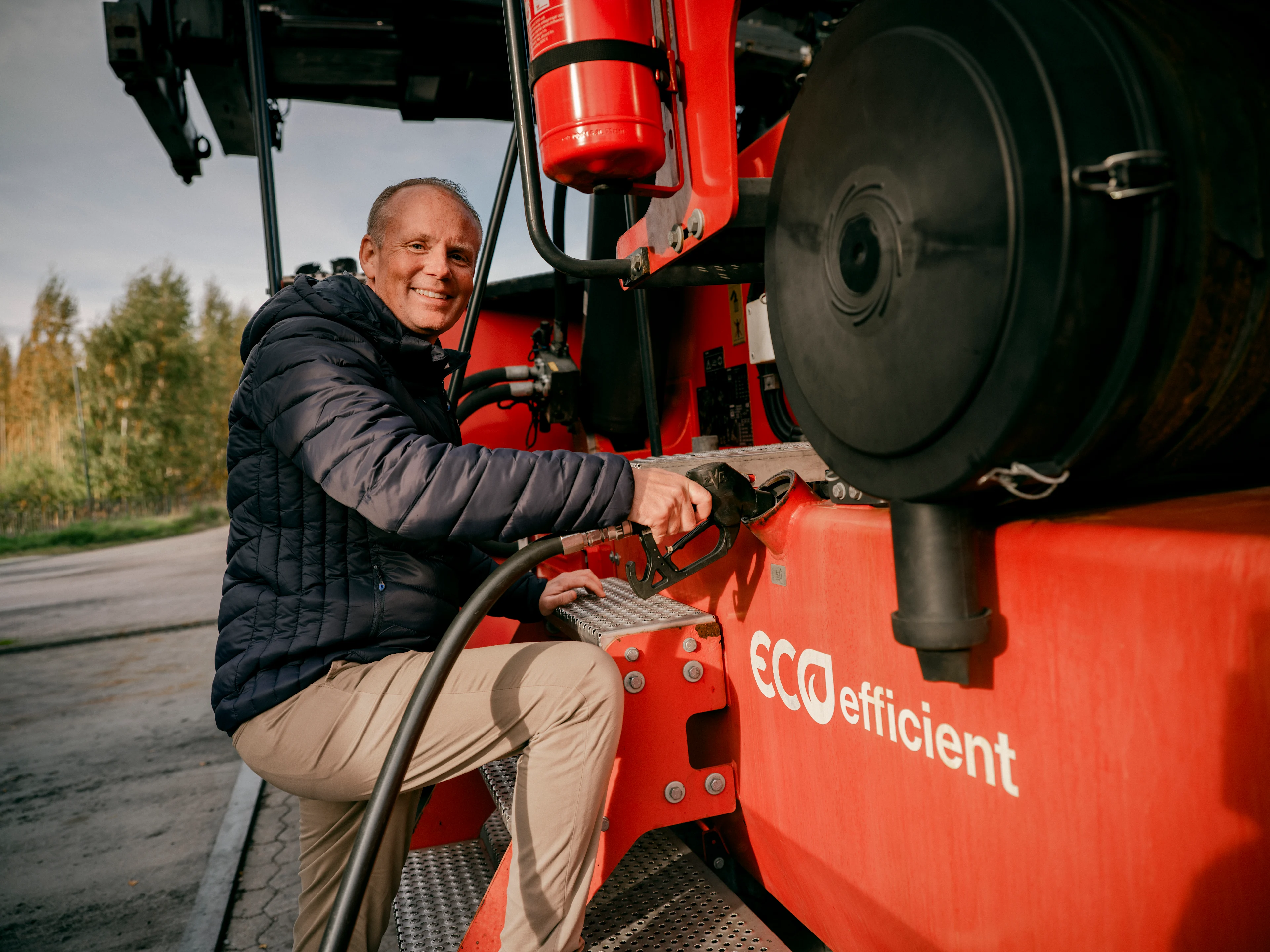
The ultimate test of any solution is its real-world application. Consider Kalmar’s reachstackers, heavy-duty powerhouses essential to port logistics globally. Fueling Volvo Penta-equipped reachstackers with Neste MY Renewable Diesel™ provides a lower-GHG-emission alternative to fossil diesel* as a drop-in fuel suitable for existing engines. *) Neste MY Renewable Diesel sold in the EU and Asia-Pacific is an HVO fuel fulfilling the EU RED sustainability criteria, including the requirement to provide at least a 50% reduction in greenhouse gas emissions over its life cycle compared to fossil fuel.
"With HVO100, operators can switch over their existing fleets," says Wernersson. "For certain sectors, it may serve as a robust intermediate step while they wait for charging infrastructure, but for remote operations such as forestry or agriculture, renewable diesel will remain a crucial long-term solution."
To support this demand, Neste is actively scaling up its global production capacity, incorporating both existing renewable raw materials and exploring future raw materials like novel vegetable oils and lignocellulosics.
When evaluating the total cost of reducing GHG emissions, the long-term cost of not taking actions is far higher than the investment required today.
While the premium cost of alternative fuels can be a hurdle for some operators, Bærentzen frames the economic reality clearly: "When evaluating the total cost of decarbonization, the long-term cost of not taking actions is far higher than the investment required today."
By prioritizing lifecycle emissions, demanding transparent sourcing, and embracing value-chain collaboration, heavy-duty industries can turn climate targets into operational reality here and now.