Aviation, News and insights
5 minute read
Neste and DHL help Stilling work towards a lower climate impact of their global deliveries
Powered by DHL’s GoGreen Plus service and Neste's sustainable aviation fuel, Danish design brand Stilling tackles its Scope 3 transport emissions without compromising on time-critical logistics.
Stilling, a family-owned Danish design company specializing in bespoke drapery hardware, has built its reputation on unique designs and a strong commitment to responsibility. Operating on a business strategy they call "Purposeful Growth," the company utilizes a triple bottom line framework, measuring success not just by financial results, but by their overall impact on people, the community, and the planet.
“Responsibility guides our decisions in everything we do, from our production and the way we consume materials to the way we treat and meet other people,” says Thomas Trads Hansen, CEO of Stilling. Guided by a "Refuse, Reduce, Rethink" philosophy, Stilling controls its internal manufacturing, avoiding harmful materials and rethinking existing solutions.
Balancing punctuality with lower climate impact
However, the company faces a friction point when it comes to global distribution. “Our product is usually part of a larger project, which makes on-time delivery absolutely critical,” Trads Hansen explains. “It's a balancing act. On one hand, delivering on time across Europe and globally, and on the other hand lowering our greenhouse gas emissions”.
For Stilling, the biggest hurdle lies in scope 3 emissions. “It's complex because it involves many external partners and it's difficult for us to control in the value chain,” Trads Hansen notes.
Powering the transition with Neste MY SAF
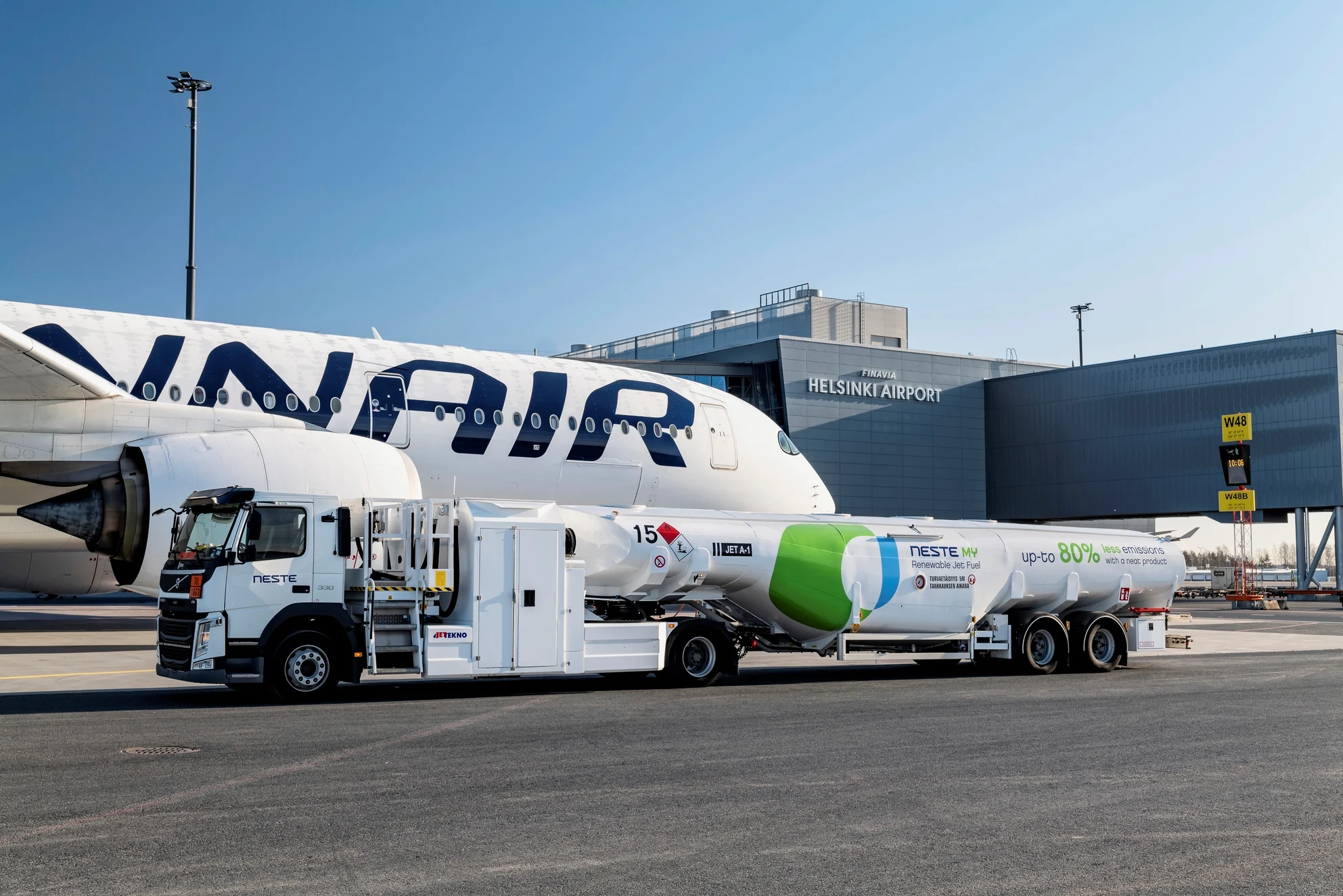
To solve this delivery and emissions friction, Stilling relies on an ecosystem of partners offering solutions that help to reduce climate impact. Neste serves as an enabler for air freight, producing Neste MY Sustainable Aviation Fuel™ (SAF), a lower-GHG-emission alternative* to fossil jet fuel.
“At Neste, we act as a strategic partner and enabler of the energy transition," explains Carl Nyberg, Senior Vice President Commercial, Renewable Products at Neste. "We provide drop-in renewable fuels that are fully compatible with current engines and fuel supply infrastructure”.
For companies that use aviation in their logistics value chain or have their own vehicle fleets, this compatibility is critical. “Renewable fuels such as SAF, provide a ready-to-use solution that helps organizations like DHL and Stilling to reduce their carbon footprint today, without requiring modifications to existing vehicles or technology,” Nyberg adds.
Bridging the commercial gap via GoGreen Plus
To bridge the gap between fuel production and commercial corporate use, Stilling turned to DHL.
“We chose DHL Express GoGreen Plus because we see it as the best solution in the market utilizing renewable fuel, meaning that we can achieve emissions reductions in our transport,” says Trads Hansen. “It feels like a partnership where both parties are aligned in making real progress and impact, which is exactly what we are looking for.”
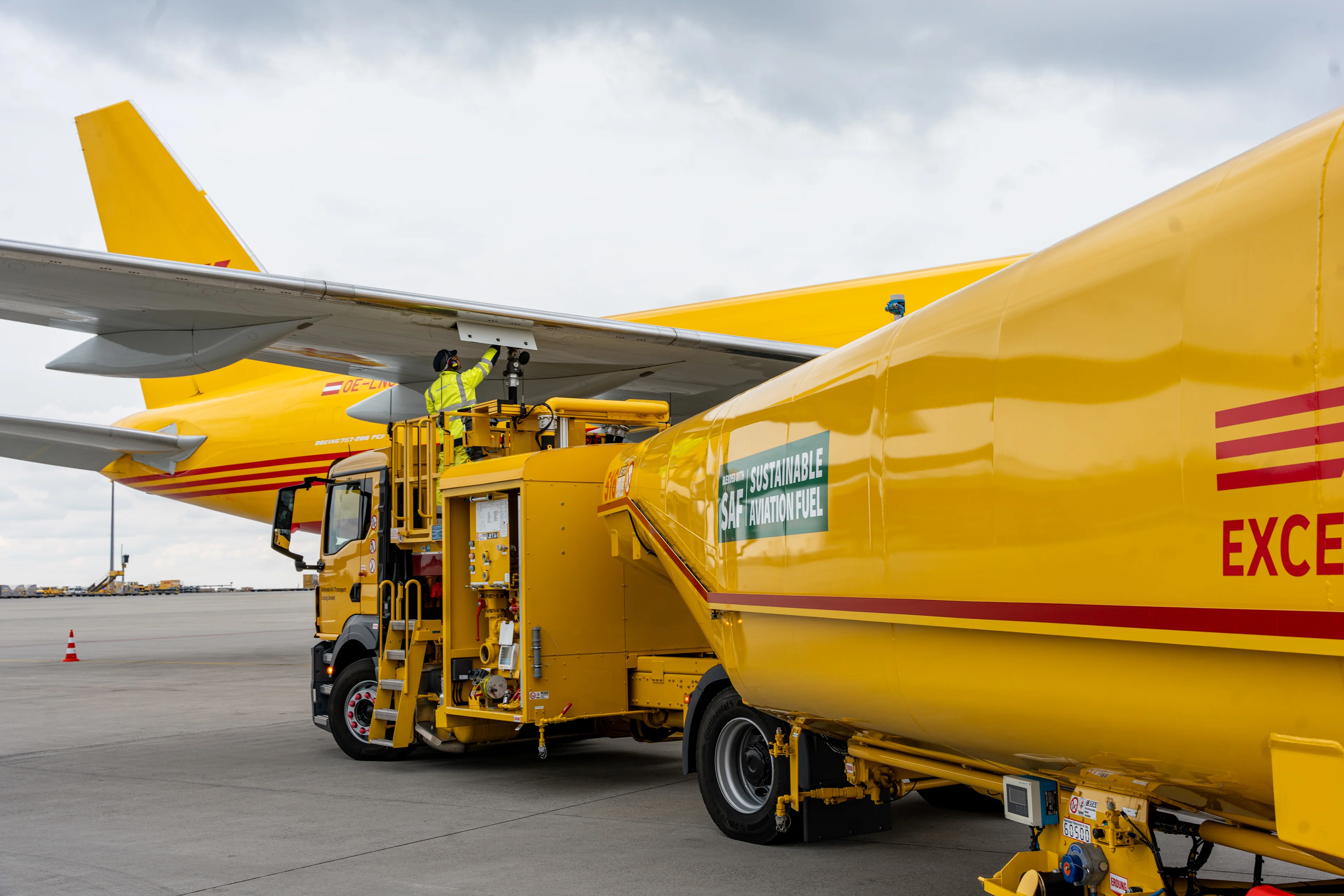
Because SAF cannot be physically available at every cargo terminal globally, DHL leverages a book and claim system to ensure its use and provide the exact traceability that companies like Stilling require.
“If you want to reduce emissions in the logistics industry, book and claim is absolutely vital,” explains Andreas Mündel, Senior Vice President, Strategy & Operations Programs at DHL Group. “We calculate how much fuel is used for a specific shipment and make sure that we have fueled that amount of SAF somewhere in our network. That way, we physically reduce the emissions but attribute it to the customer who's willing to pay for it and who buys our GoGreen Plus service”.
This verified approach seamlessly integrates into existing business operations. “Much like SAF is a drop-in solution for us, a book and claim product is a drop-in for our customers,” Mündel emphasizes.
Scaling lower climate impact logistics together
Systemic value chain emission reductions require scaling both supply and demand concurrently. The collaboration between Stilling, DHL and Neste proves that expectations are changing and industry targets can be turned into direct execution.
Markus Otto, Executive Vice President Global Aviation at DHL Express, emphasizes that to make these lower carbon footprint solutions more accessible, the industry must focus on scaling up. "We have to ensure that more SAF becomes available," Otto explains. "There has to be a larger scale of availability so that the unit costs come down".
To accelerate this shift, DHL supports regulatory measures. “We are already exceeding the levels required by the ReFuelEU mandate and support the mandating of SAF if it helps to stimulate further production and use,” Otto says.
Ultimately, this seamless collaboration functions as an inspiring example. By empowering DHL to offer solutions like GoGreen Plus, Neste can help end-customers such as Stilling work towards their climate targets*.
“This partnership serves as a proof of concept for large-scale decarbonization,” concludes Nyberg. “By demonstrating the operational feasibility and lower-climate-impact* of renewable fuels, the Neste-DHL partnership provides a blueprint for other organizations to follow.”
*) Neat, i.e. unblended, Neste MY Sustainable Aviation Fuel fulfills the ReFuelEU Aviation criteria, including the requirement to provide at least a 65% greenhouse gas emission savings over its life cycle when compared to fossil fuel. While SAF and fossil jet fuel release similar amounts of CO2 during flight, SAF’s life cycle climate impact is smaller than fossil jet fuel’s. SAF is certified for commercial use and can currently be blended up to 50% with conventional jet fuel.