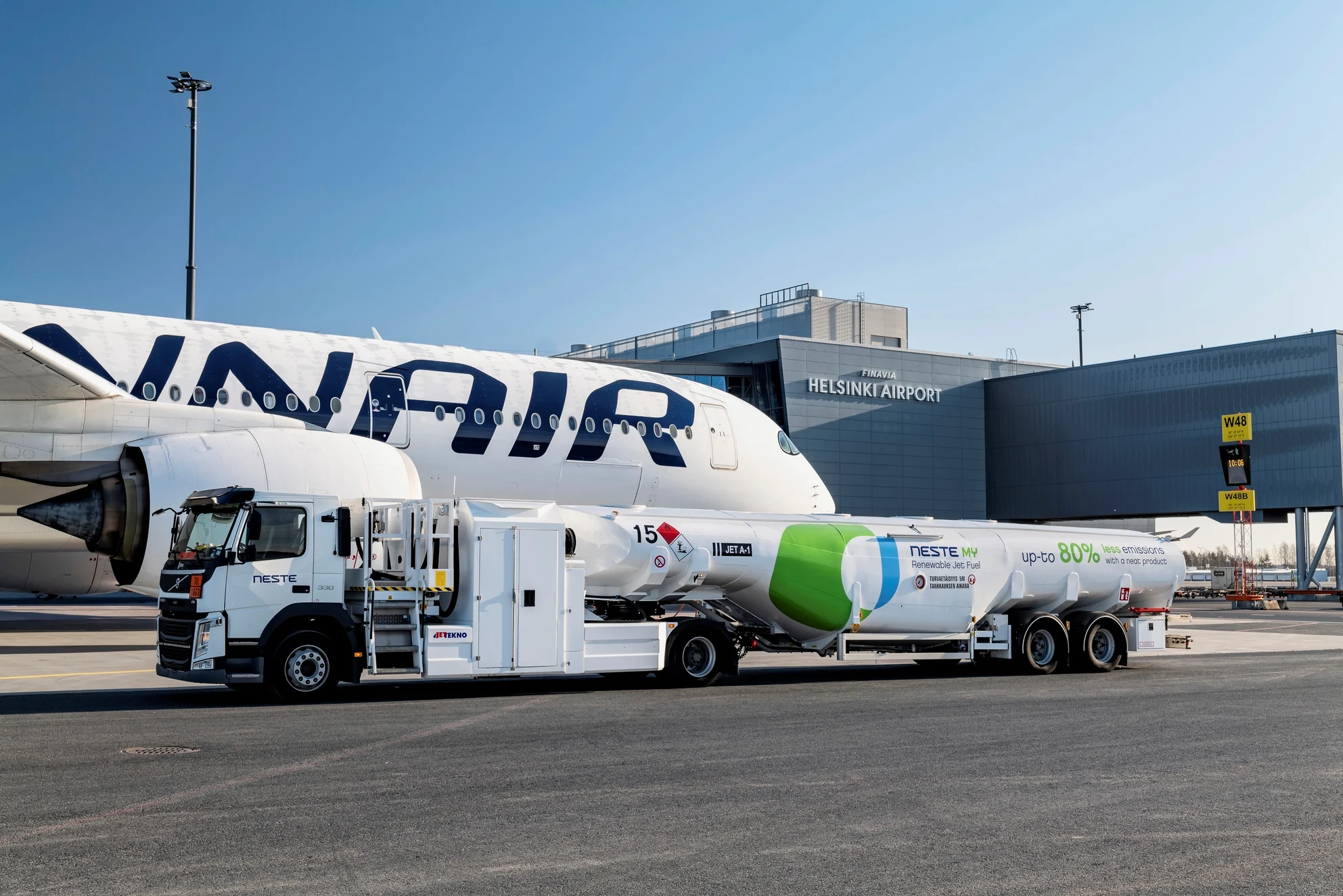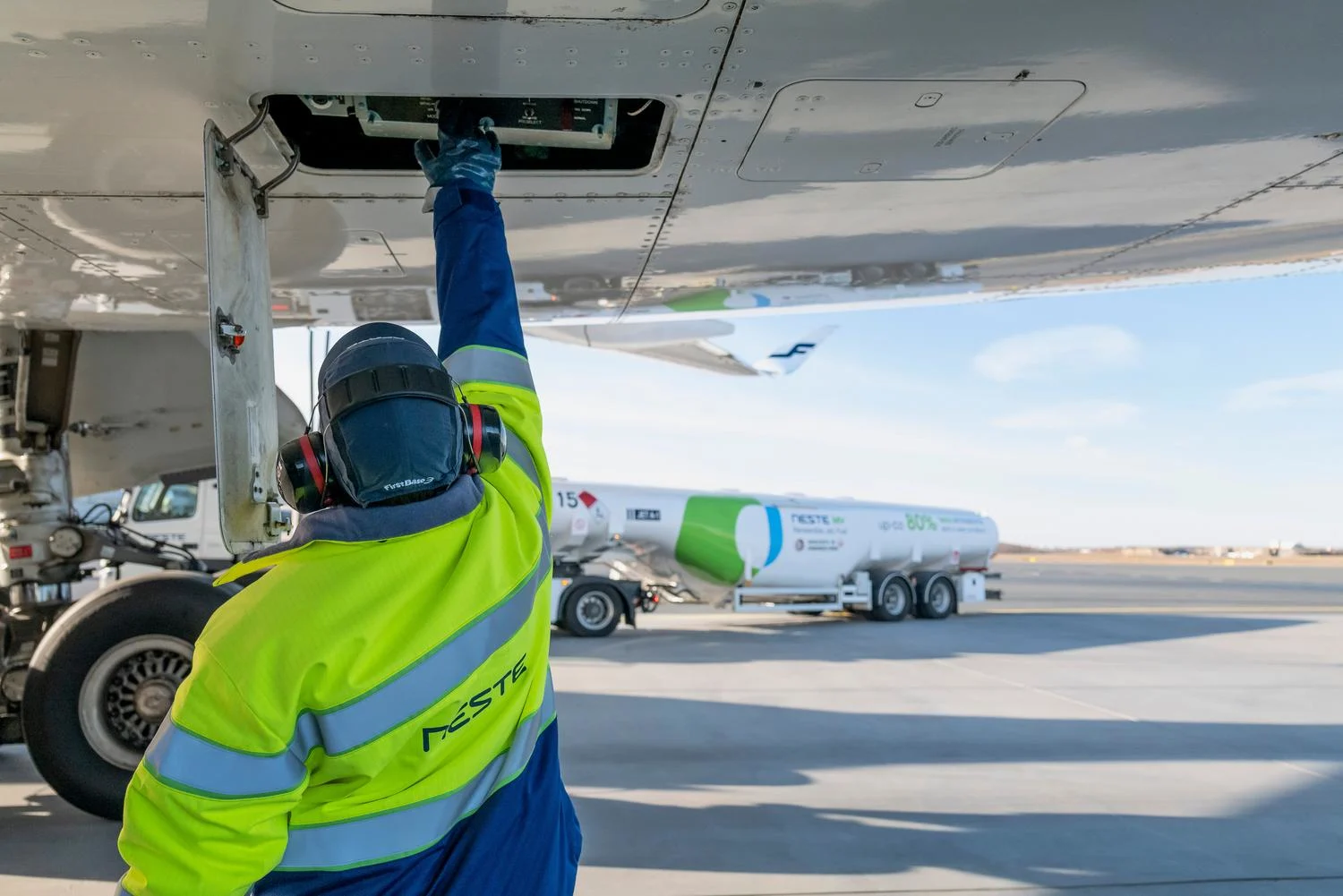
Neste MY Sustainable Aviation Fuel™ – A lower-GHG-emission alternative* to fossil jet fuel
Neste MY Sustainable Aviation Fuel (SAF) is a lower-GHG-emission alternative to fossil jet fuel, readily available to help reduce greenhouse gas (GHG) emissions* in aviation.
*)Neat, i.e. unblended, Neste MY Sustainable Aviation Fuel fulfills the ReFuelEU Aviation criteria, including the requirement to provide at least a 65% greenhouse gas emission savings over its life cycle when compared to fossil fuel. While SAF and fossil jet fuel release similar amounts of CO2 during flight, SAF’s life cycle climate impact is smaller than fossil jet fuel’s. SAF is certified for commercial use and can currently be blended up to 50% with conventional jet.
Why Neste MY Sustainable Aviation FuelTM?
Flying connects our world, supports global business and enables essential movement. But to preserve these benefits for the future, the aviation industry must address its climate impact and transition away from its reliance on fossil fuels.
Neste MY Sustainable Aviation Fuel is a lower-climate-impact alternative to fossil jet fuel, and has lower greenhouse gas (GHG) emissions* over its life cycle compared to fossil jet fuel.
Neste MY SAF is a drop-in solution and fully compliant with ASTM D7566 specifications. The fuel is ready for use in existing aircraft engines and airport infrastructure once blended with fossil jet fuel*.
Why Neste?
Neste is the world's leading producer of SAF, offering SAF made from renewable waste and residue raw materials, such as used cooking oil and animal fat waste. Neste has a global SAF production capability of 1.5 million metric tons per annum at our refineries in Finland, Singapore and Netherlands. This will grow to 2.2 million metric tons per annum in 2027.
To ensure supply chain integrity, every stage of our sourcing is verified through regular third-party audits, ensuring all raw materials meet strict legal requirements and our own Responsible Sourcing Principles. Read more.
*Neat, i.e. unblended, Neste MY Sustainable Aviation Fuel fulfills the ReFuelEU Aviation criteria, including the requirement to provide at least a 65% greenhouse gas emission savings over its life cycle when compared to fossil fuel. While SAF and fossil jet fuel release similar amounts of CO2 during flight, SAF’s life cycle climate impact is smaller than fossil jet fuel’s. SAF is certified for commercial use and can currently be blended up to 50% with conventional jet fuel.

Reduces GHG emissions
Neste MY Sustainable Aviation Fuel has lower GHG-emissions* over its life cycle compared to fossil jet fuel.

Made from renewable raw materials
Neste MY Sustainable Aviation Fuel is produced from renewable waste and residue raw materials, such as used cooking oil and animal fat waste.

100% compatible with existing aircraft engines
Neste MY Sustainable Aviation Fuel is a drop-in solution which is ready for use in existing aircraft engines and airport infrastructure once blended up to 50% with fossil jet fuel.
*)Neat, i.e. unblended, Neste MY Sustainable Aviation Fuel fulfills the ReFuelEU Aviation criteria, including the requirement to provide at least a 65% greenhouse gas emission savings over its life cycle when compared to fossil fuel. While SAF and fossil jet fuel release similar amounts of CO2 during flight, SAF’s life cycle climate impact is smaller than fossil jet fuel’s. SAF is certified for commercial use and can currently be blended up to 50% with conventional jet fuel.
Leading brands taking action
Neste MY SAF provides a safe, readily available, and proven solution used by many leading commercial airlines, including Air France-KLM, Lufthansa, United Airlines and All Nippon Airways, and cargo carriers such as DHL Group, Amazon Prime Air and FedEx.

DHL Group
“The beauty of SAF is that we can drop it into the fuel tank and use it as is with existing aircraft, fuel tankers, and our current fuel infrastructure”
Delta Air Lines Inc.
“With around 90% of the industry’s carbon emissions coming from jet fuel, focusing on the fuel we use and how we use it is essential to reaching net zero”.

Airbus
“SAF is vital for the future of aviation; yet as an industry, we need the help of supporting regulations to stimulate production and availability of SAF” .

All Nippon Airways
“Our partnership with Neste is a major achievement in demonstrating that SAF is actually available and that there are credible decarbonization options available today.”
Neste MY SAF is available globally
Neste MY SAF is available directly via Neste at key global airports, including San Francisco International Airport (SFO), Los Angeles International Airport (LAX), Frankfurt Airport (FRA), Amsterdam Airport Schiphol (AMS), Changi Airport (SIN), and Narita International Airport (NRT), and via distribution partners at other airports. Neste's current SAF production capability is 1.5 million metric tons per annum and will grow to 2.2 million tons per annum in 2027.
>70
Direct customers using Neste MY SAF
>25
Key airports where Neste MY SAF is directly available
Releases and news
Here you can find our latest press releases and news on sustainable aviation fuel.